

Why we don't open branches — the bottleneck was never money, it's teachers
The advice we hear most often is to open more locations. We never have, and the reason isn't capital: teachers who can carry a hands-on experiment class barely exist. So we took another route — licensing our materials out, and signing away our own right to teach in the area.
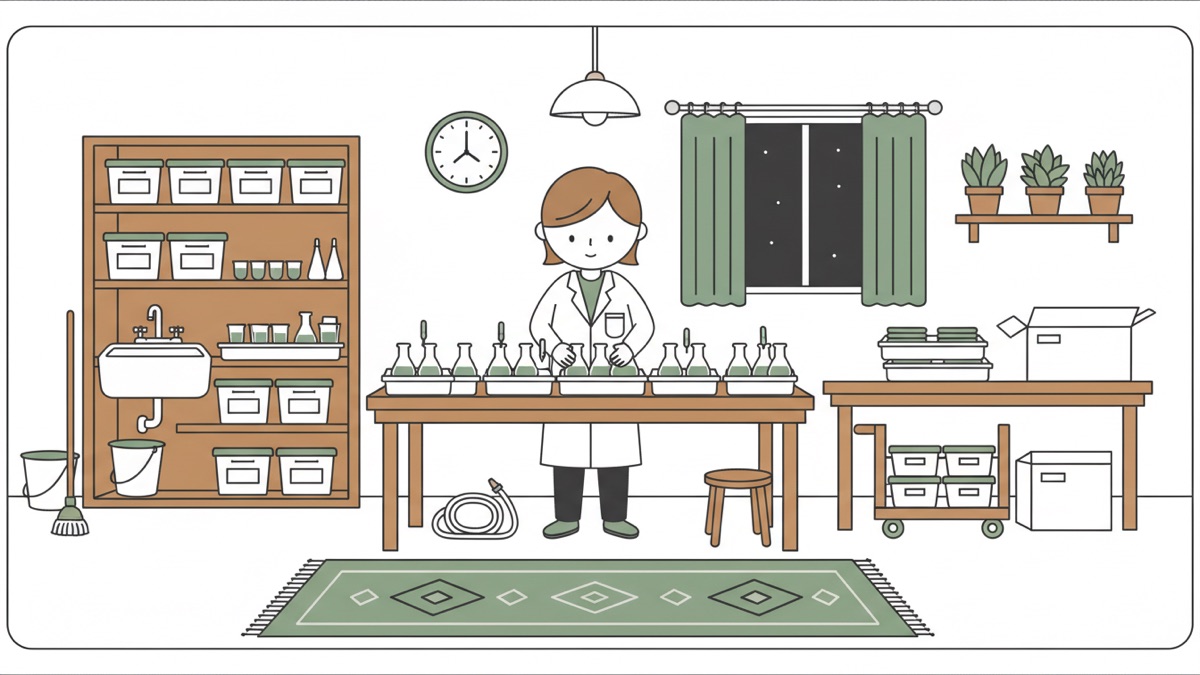
The advice we've heard most often over the years is to open a few more locations.
We never have. Not for lack of considering it, and not simply for lack of capital — the real bottleneck sits somewhere else.
What it actually takes to run one experiment lesson
Through the summer and winter peaks, a day for one of our teachers runs like this: doors open at eight, teaching from nine straight through to nine at night, then the equipment to put away afterwards. Almost all of it on their feet. Seven days a week, nine weeks straight.
This isn't a complaint. The point is that a hands-on class and a lecture-based one are not the same order of work.
If children are going to handle the equipment, someone has to prepare it, portion it out and trial-run it beforehand, then wash it, return it and restock the consumables afterwards. All of that sits outside lesson time where parents never see it, and there is enough of it to need dedicated help. It is also what decides how many lessons one teacher can run in a day.
So a teacher who can carry an experiment class needs three things at once: the willingness to prepare both lesson and materials, the ability to hold a room, and the discipline to hold the safety line. Very few people have all three.
That, not ambition, is why we have never spread across the country. We simply cannot find that many such people.
We won't fill the gap by training someone up in a hurry
It has been suggested to us: recruit a few university students, train them briefly, put them in front of a class.
We can't do that. The risks in an experiment lesson are physical — flame, chemicals, blades and glassware, all in children's hands. With a teacher who can't hold the room, an accident is only a matter of time. And there is no shortcut to lesson preparation either; it takes having taught something several times to know which step a child will stall on and which step goes wrong.
So every year some families don't get a place, and all we can do is apologise. We don't have a better answer to that.
(Why we have only ever gone deeper into experiments rather than broader, we wrote about in the one stubborn thing we've bet the lab on.)
Rather than expand ourselves, lower the barrier for the whole field
But being unable to reach more children still needed an answer.
So we license our teaching materials to others who want to work in science education, and we help with their teacher training and materials preparation, handing over how we plan lessons and how we run the place. We also sign away our own right to teach in that area, and include a period of free updates to the materials.
Some in the field find the non-compete hard to understand. The reasoning is straightforward.
The market for science education is nowhere near as mature as the one for English. Equipment is expensive, preparation is heavy, and few people can teach it — so few people commit to it. And while few commit, the cost never comes down, and the children are the ones it limits.
Once enough people discover that teaching science won't leave them broke, more of them will build materials and step into the classroom. Only then does the cost of science education stand a chance of falling.
Another lab in a given area running experiment lessons well is good for the children there. That matters more than us opening a branch in it.
So we chose to stay put and go deeper
We haven't rolled out territory. The weight has gone instead into developing lesson material and putting it out into the world.
The price of that choice is that our scale stays small. What it buys is this: we know every one of our students, and we can hold the standard of every lesson — and both of those get very hard to guarantee once the branches go up.