

Safety in the lab isn't the same as nothing going wrong
Liquid nitrogen does not belong in a vacuum flask — basic knowledge, and still not universal. The harder problem is the one behind it: a class designed to be perfectly safe can teach children to stop noticing danger altogether.
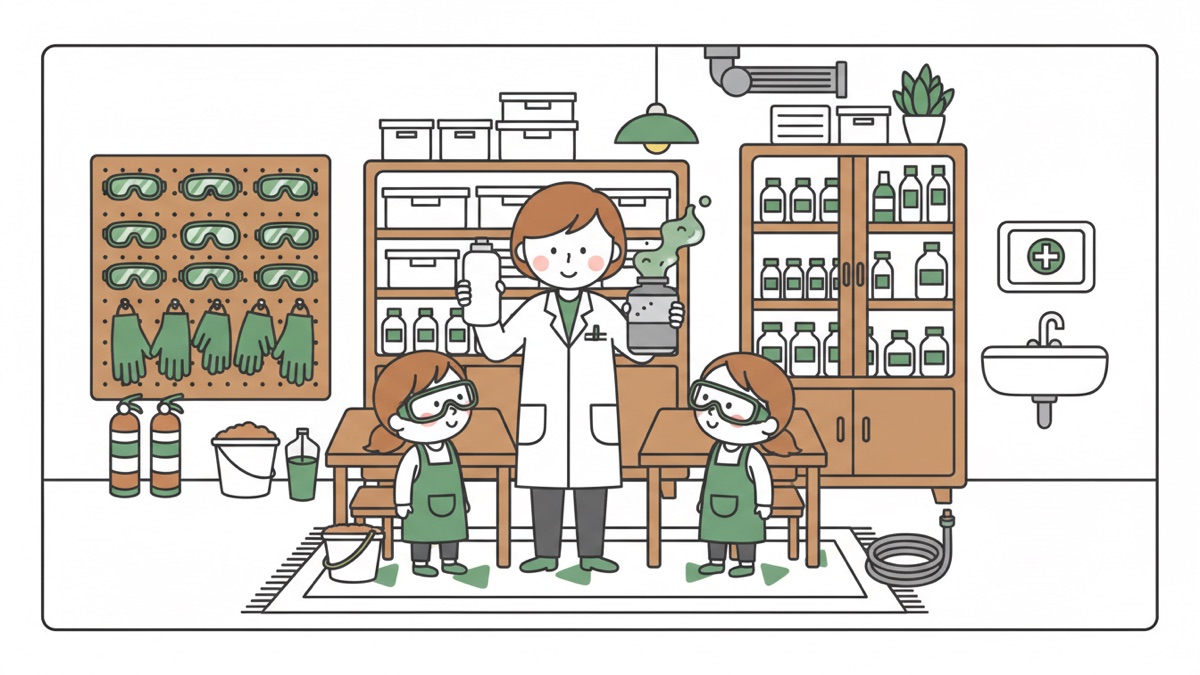
Safety in a lab has two layers. The first is equipment and procedure: get it right and nothing goes wrong. The second is harder — whether a child can see for themselves where the danger is. And the better the first layer works, the easier it is to neglect the second.
Liquid nitrogen does not belong in a vacuum flask
Liquid nitrogen vaporises rapidly at room temperature, so it has to be stored in a Dewar flask — a vessel built to hold −196°C (−321°F) and designed with a vent that releases pressure. One costs tens of thousands of New Taiwan dollars, from roughly a thousand US dollars upwards, with the range coming down to capacity and how it seals.
An ordinary vacuum flask will not do. As a brief intermediate container it just about passes, but the moment you put a lid on it, it becomes genuinely dangerous, for two reasons:
- The materials in a vacuum flask can go brittle at extreme cold. Metal and glass at −196°C behave nothing like they do at room temperature; a knock is enough to shatter them.
- The nitrogen keeps vaporising and expanding. In a sealed container with no vent to match, internal pressure simply builds until the vessel bursts.
Liquid-nitrogen taster sessions have become common in recent years, but this piece of knowledge hasn't spread with them. If your child is going to one, it's worth asking a single extra question: what is the liquid nitrogen being kept in?
A class designed to be too safe teaches children to stop seeing danger
Our lessons have been tested and adjusted many times over, precisely so that children can throw themselves into them without anything going wrong. But that approach has a side effect we didn't anticipate: because nothing ever goes wrong, children conclude that doing experiments is inherently safe.
We've had children still messing about while alcohol was leaking across the bench. Not out of defiance — they genuinely didn't register it as a problem. In their experience, an experiment had never once gone wrong.
So we now name the danger deliberately: why this substance can injure you, the conditions under which it does, and what the first move is if something happens. The point of a liquid-nitrogen lesson was never the clouds of white vapour. It's that the more dangerous a thing is, the more you need to understand it. A child who has never been shown where the danger lies is the least protected one in the room when they meet the same material somewhere else.
The rules we don't negotiate
Which is why a few rules leave no room for discussion:
- Anything involving flame or chemicals waits for the instructor's word. Nobody starts early.
- Nothing on or around the bench is picked up without permission.
- The chemical store at the back of the room is off limits to students under all circumstances.
If a child repeatedly won't comply, we ask their family to take them home. That sounds severe, but an accident in a lab usually needs only one lapse of attention, and the person affected is rarely just the child who lapsed. We've never been soft about what we expect in the room — great fun, and genuinely strict makes the same point.
A safe experiment class isn't one where nothing can happen. It's one the child walks out of able to recognise, on their own, where the danger is.