

What if they can't even set up the equation? The problem usually isn't maths — it's reading the question
"Can't read the question" is rarely just weak reading. It's being unable to turn words into a picture. Without the picture, the question is a string of unfamiliar symbols. Get them comfortable with text first, then build the picture, and only then drill the reasoning — in that order, or it stalls.
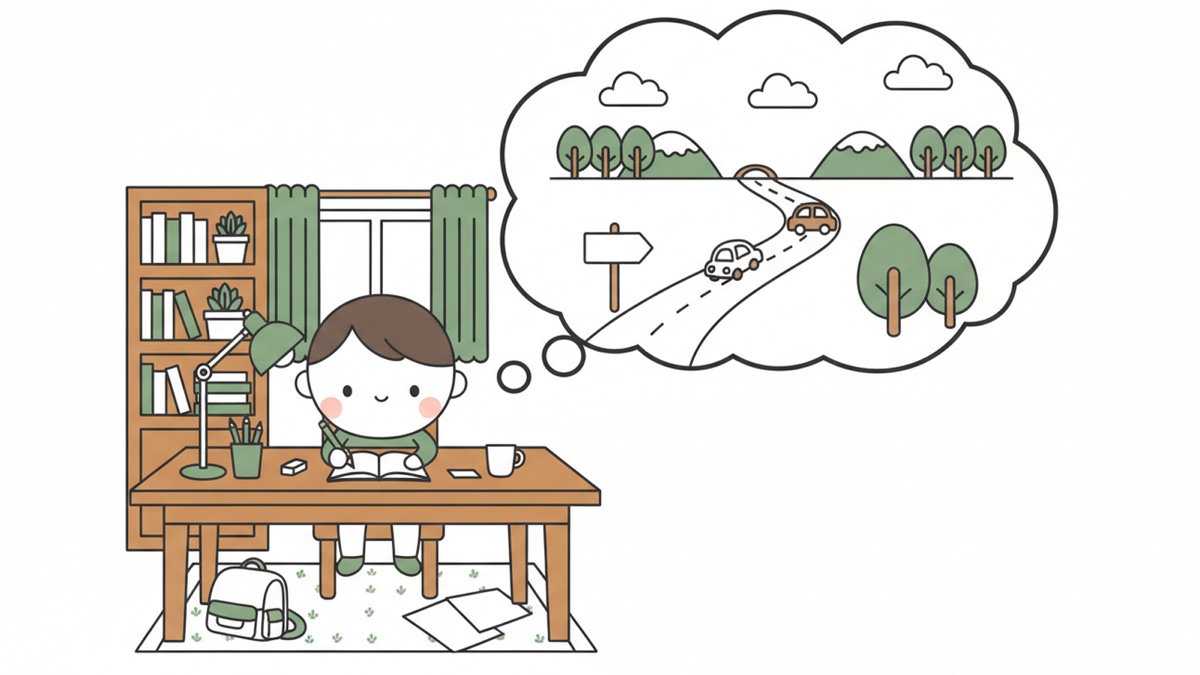
The last piece covered why writing out full working matters so much. The follow-up question parents ask is always the same: what if the child can't even set up the equation?
Everyone has heard the answer: they can't read the question.
But "can't read the question" is more complicated than it sounds. It isn't only weak reading comprehension. The deciding factor is being unable to turn the words into a concrete picture — and without that picture, there's nothing to reason from.
The picture is the real bottleneck
Word problems describe situations that are abstract to a lot of children. If no image forms in their head, the sentences are just a string of unfamiliar symbols, and there's no way forward.
So the first move isn't more practice questions. It's the ability to connect words to images.
And the material for building that ability is something most children have already met: animation, picture books, and early chapter books.
Cartoons work through motion, which makes them unusually good at building intuition for change of state. Take the classic two-vehicles-approaching problem in rate questions — the image a child forms of two things closing in and meeting usually traces back to something animated they once watched.
Picture books and early chapter books do the same job from another direction. Simple sentences with a few illustrations let a child rehearse "read the words, see the picture" over and over. As the illustrations thin out and the text takes over, they can already fill in the picture themselves.
The value here isn't confined to maths. Reading comprehension sits underneath every subject.
So isn't buying a comprehension workbook the fastest route?
We don't recommend it, for a very practical reason.
Comprehension workbooks draw their passages from news reports and popular science — informative, but with almost no story in them. For a child who already dislikes reading, that material is dry and won't hold them. They try a few and quit.
The bigger risk is what it teaches them about reading itself. If a child's first sustained experience of reading is exam material, it's easy for reading and pressure to fuse together, and for text to become something they resist on sight. That's the opposite of what you were trying to achieve.
The goal at this stage is modest: get the child to stop resisting text. Clear that bar first. Training them to extract key points from comprehension passages is a conversation for later.
Get the order wrong and nothing moves
Three steps, and the order isn't negotiable.
One: lower the fear of text. Start short. Picture books, early chapter books, comics — anything works, as long as reading stops feeling like a chore within a reasonable stretch of time.
Two: build the picture. Once text isn't repellent, the child can settle enough to actually understand a sentence. Understanding is what triggers the image; the image doesn't come first.
Three: then drill the reasoning. With the first two in place, reasoning practice moves quickly. A month of honest effort usually shows a clear difference.
And do it as early as possible — ideally finished during elementary school. By junior high the abstraction level of the questions steps up sharply, and a child patching their reading at that point is carrying two problems at once.
So don't reach for more practice yet
When a child stalls in maths, ten more past papers usually won't help — because the step they're stuck on isn't the calculation.
Check first whether they can read the passage, and whether anything appears in their head when they do. If nothing does, what needs work is reading, not maths.