

Letting children lead: four principles we've tested and retested
A parent looked at what their child had built and asked: isn't this just woodwork? It is woodwork. But from the first idea through measuring, cutting, sanding, screwing, soldering and writing the code, we hand all of it to the children. Over ten days the hard part is never the making — it's learning to work with other people. And every time we let go a little more, they go a little higher.
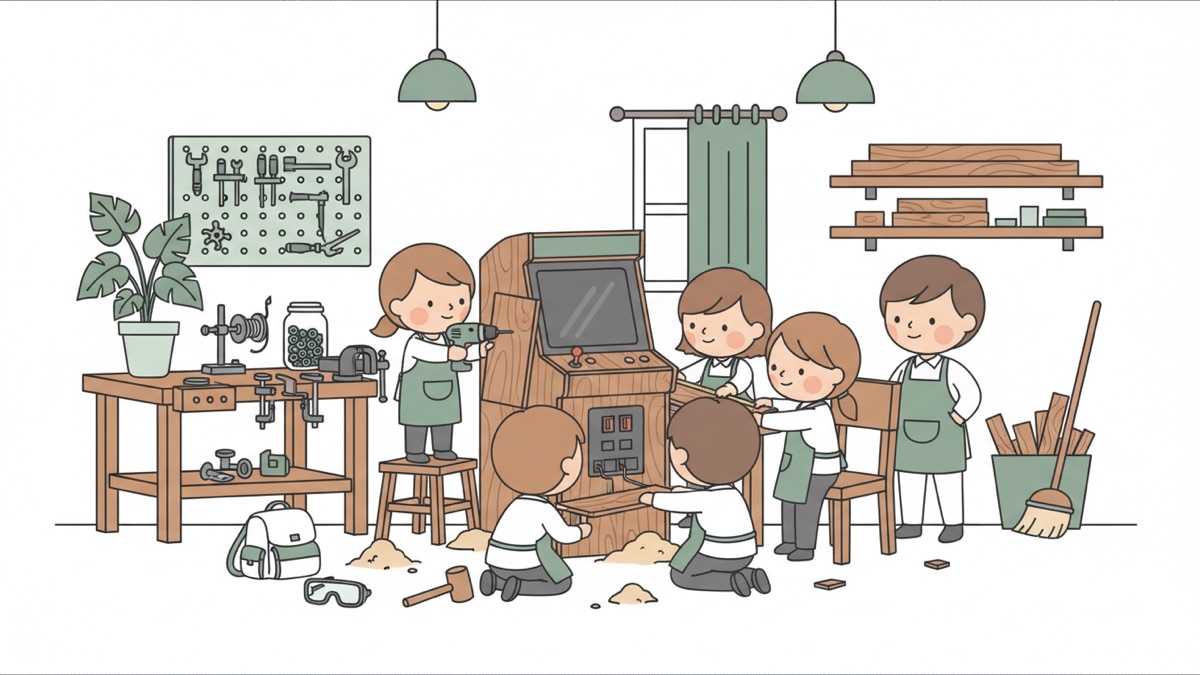
A parent looked at what their child had built and asked us: isn't this just woodwork?
It is woodwork. But from the first idea through measuring, cutting, sanding, screwing, soldering and writing the code, we hand all of it to the children themselves. Ten consecutive days of it, revised year after year, left us with four principles.
One: the teacher guides, the child leads
A teacher's job here is to hand the question back, not to demonstrate once and have the child copy it.
Copying is faster, of course, and the result looks better. But what comes out of copying isn't theirs. The test is simple: ask why they joined it that way, and if they can answer, the piece genuinely belongs to them.
Two: the hard part isn't the making, it's the talking
When a group builds something large together, the first thing to jam is never the technique.
It's disagreement, or one person working three times faster than another, or the fact that nobody ever said clearly who owned which section. We spend at least as much time on that as on technical instruction.
Which is why the brief has to be big enough: a project one child could finish alone teaches nothing about collaboration. Dividing the work, arguing, redividing it, covering for each other — all of it has to be forced out by the difficulty of the task.
Three: give the goal, not the steps
We give a goal and a set of constraints. We don't give a sequence of steps.
What follows is testing, adjusting, testing again, adjusting again, more times than anyone counts. It looks unremarkable from the outside, even dull. But the reflex it builds — this has stopped working, so I'll go and find out why — is what we actually want them to keep. That posture in front of a problem stays with them a long time.
Four: let go a little more, and they go higher
Every year ends with us realising we were still protecting them too much.
By the last day, the children have finished something they didn't believe at the start they could build: a working arcade-style machine, an escape-room rig that only runs once the sensors and the code agree. And what stops the adults in their tracks usually isn't the object. It's the way the children handle their tools — a drill braced one-handed, the movements practised, far too fast for someone who a month earlier had to be nagged into doing their homework.
What we take from it is this: the children didn't suddenly become capable. They always were. They are simply rarely handed anything real.
Finishing something hard with your own hands will not turn a child into a joiner. But it will start them believing they can solve problems — and that matters far more than the object does. The same conviction later went into the engineering work we do with older students, which we've written about in why we bring university engineering to teenagers.