

When something looks easy, it usually means someone has absorbed the hard part
We're regulars at a metal shop, cutting larger plates. The owner names an alloy at a glance and calls its thickness with it. Years of building experiments have left us indebted to tradespeople of every kind — and surer of one thing: you only find out where the expertise is hidden once you've tried it yourself.
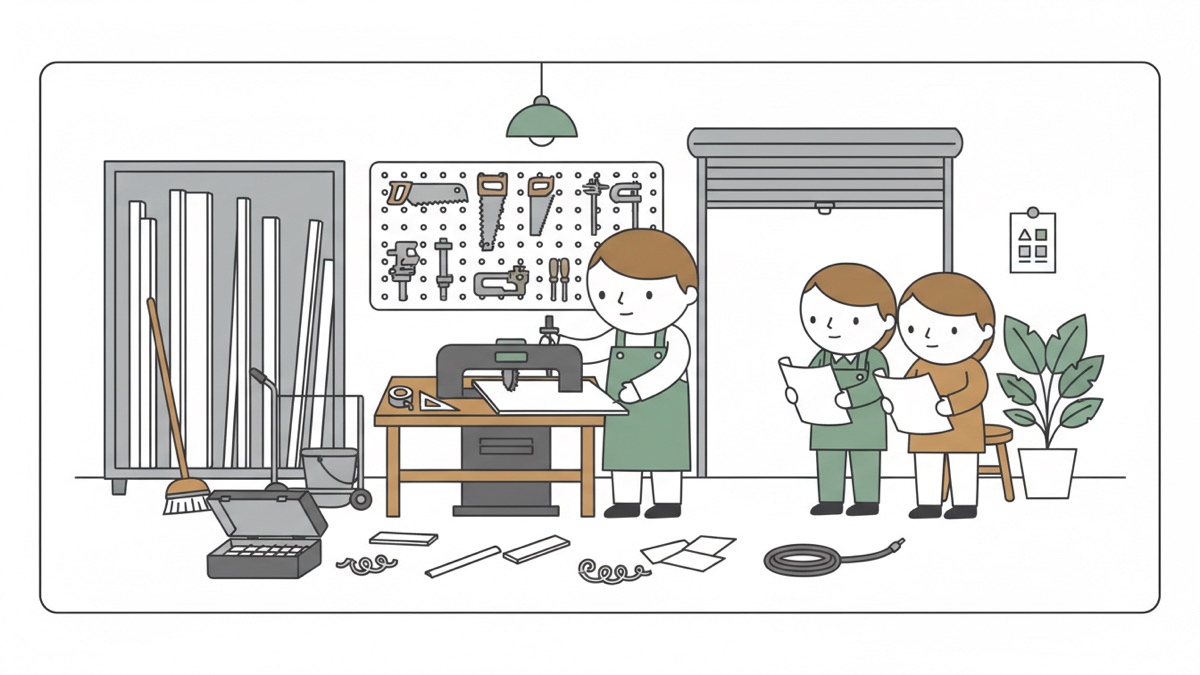
We were back at the metal shop, this time to have a larger Chladni plate cut.
Walking in always leaves us slightly in awe. There is more metal in that shop, in more varieties, than you could count in a glance, yet the owner names an alloy on sight and calls its thickness with it. The cutting itself is quick and clean, and looks like nothing at all.
Measuring accurately is a craft in its own right
It films beautifully, and it makes the work look simple. But anyone who has made something with their own hands knows the hard part usually isn't the cutting. It's the measuring.
When we saw a length of timber ourselves, the line looks perfectly drawn and the cut still comes out crooked. Where did the error creep in — the width of the pencil line, the rule not sitting flush, the blade drifting, the stock shifting in the clamp? You only learn that by getting it wrong, repeatedly.
When something looks easy, it usually means someone has already absorbed the hard part. An outsider never sees that absorption happen, which is exactly why they assume it was easy to begin with.
Behind one science classroom stands a whole street of tradespeople
We've built a fair number of experiments over the years, and got stuck on many more. What has rescued us is rarely anything high-tech. It's tradespeople: locksmiths, carpenters, metalworkers, electricians, CNC machinists, mould makers, fastener suppliers, glaziers, painters, the man who repairs roller shutters.
Once, the remote went missing and we couldn't get the shutter open. We had been out running a camp all day, and it was the middle of the night by the time we got back. In the end a locksmith agreed to come out, jacked the shutter open, and did it without damaging the door. That was the moment it became concrete for us: a craft can dissolve in a few minutes a problem you have absolutely no answer to.
Any job done long enough grows techniques that only the person doing it knows. That is knowledge too. It just isn't written down.
This is also what we want children to feel
What happens in that shop and what happens in our classroom are the same thing.
Once a child has sawn a crooked line themselves, measured something wrong themselves, and had to start over, they look at any finished object differently. They know there was a process behind it, and they know somebody practised that process into existence.
We've always held that you only truly understand something once you've done it with your own hands. Turned the other way round, the same sentence reads: once you've done it yourself, you know who deserves your respect.