

Run the experiment first, explain the theory after
People assume that pairing theory with hands-on work means you'll never finish the syllabus. In our experience the opposite is true — because a child has to see something happen before the explanation can land.
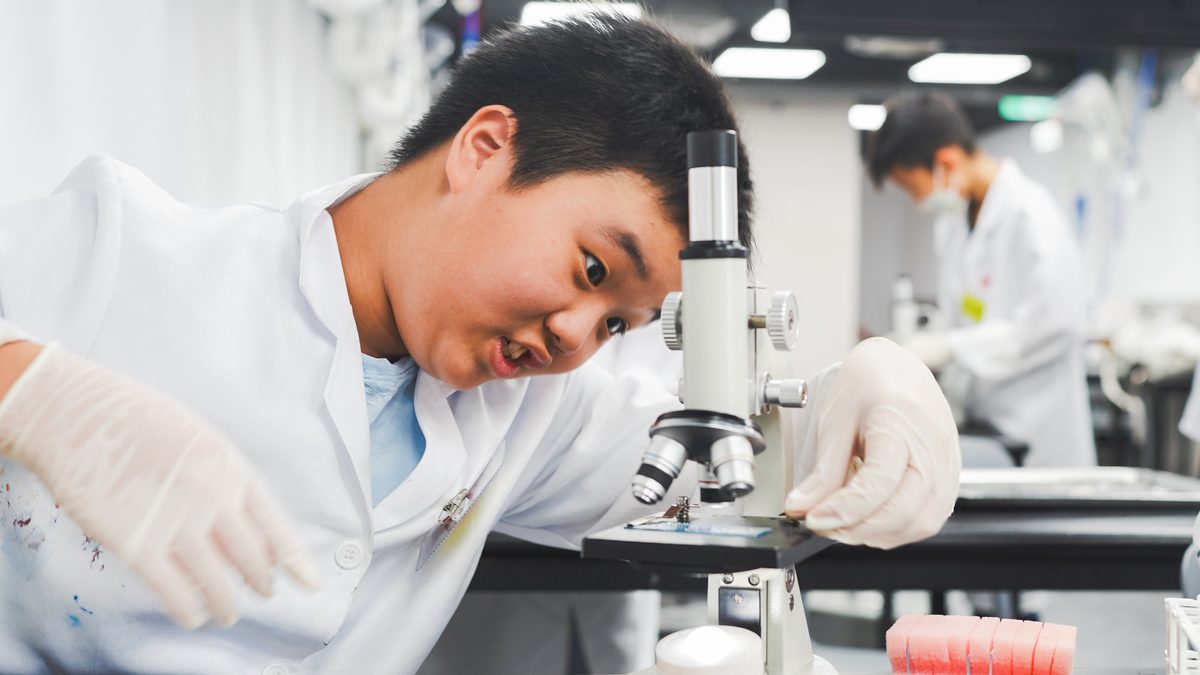
Plenty of people don't believe you can really cover theory and experiment in the same lesson — they assume you'd never get through the material. In our experience it's the other way round. Get the order right and it's actually faster.
The order is the whole trick: do the experiment first, explain the theory afterwards. A child has to see the phenomenon before your explanation can mean anything.
See it first, then it sticks
Somewhere else, "the heart and blood vessels" might have to be explained three times over. We have children dissect a real pig's heart and watch blood actually flowing through the tail of a small fish — and then we run through the key points. They remember almost all of it.
Exams love the compound microscope: when an object is drifting across the field of view, which way do you nudge the slide? Plenty of children have to reason it out painfully in their heads. A child who has actually worked a microscope dozens of times answers without a moment's thought — the experience lives in their hands.
Hand moves, eyes move, then the brain moves
The principle is simple: the hand moves first, which makes the eyes move; once the eyes are moving, the brain follows.
Once you've seen what hands-on work does, you understand how hollow the alternative is — having a child memorise the steps of an experiment they have never actually performed. It's inefficient, and it's close to meaningless.
Watching is never enough: the mapo tofu problem
Here's a well-worn analogy that happens to fit perfectly.
You can watch a famous TV chef make mapo tofu a dozen times and still have no idea how much of each seasoning to add, or how far to reduce the sauce. If watching recipes and cooking shows were enough, every household would have its own celebrity chef. They don't.
Experiments are the same. Knowledge doesn't become yours because someone said it out loud near you. It has to pass through your own hands and your own eyes before it's genuinely yours.