

How we design a class: start by asking how scientists know this
There is no shortage of dinosaur courses, and we built one anyway. The reason is that the two questions we most wanted answered usually aren't: how were the geological periods drawn up in the first place, and who names a dinosaur — on what grounds do they call it a separate species? The depth of a class depends on whether its designers are willing to chase questions like that, and whether they are willing to make the hands-on part something other than a toy.
"There are already plenty of dinosaur courses out there. You're making another one?"
We were asked that more than once while designing this class. It's a fair question, and the answer happens to explain how we plan courses generally.
The first test: would we want to sit through it ourselves
Our division of labour is fixed. One of us is responsible for the subject and the angle, against a single criterion — that we would want to sit and listen to the whole thing. The other is responsible for turning that into a structure that explains it clearly and takes it all the way down.
What the split guards against is one specific failure: people who know a subject well tend to say what they find interesting, and forget whether the room can follow. Only when someone is permanently stationed on the listener's side does the material stop drifting inwards — into a set of technically correct terms that nobody can stay awake through.
The second test: how do scientists know this
Take the geological periods. Most books simply list the names. It looks thorough, but it never answers the question that comes before it: how were those periods divided up? On what evidence? How was it confirmed?
Naming dinosaurs is the same. There are field guides everywhere, but who actually names these animals? When the bones look so alike, what justifies calling them separate species?
That is what we actually want a student to leave with. Names can be memorised and remain useless; once a child grasps how something came to be known, the way they look at every other subject shifts too. They start asking what the grounds are, rather than only what the answer is.
The third test: the hands-on part can't just be a prop
Almost every dinosaur course includes a dig. But what most children pull out of the sand is visibly a toy — good for a laugh at the time, forgotten by the time they get home.
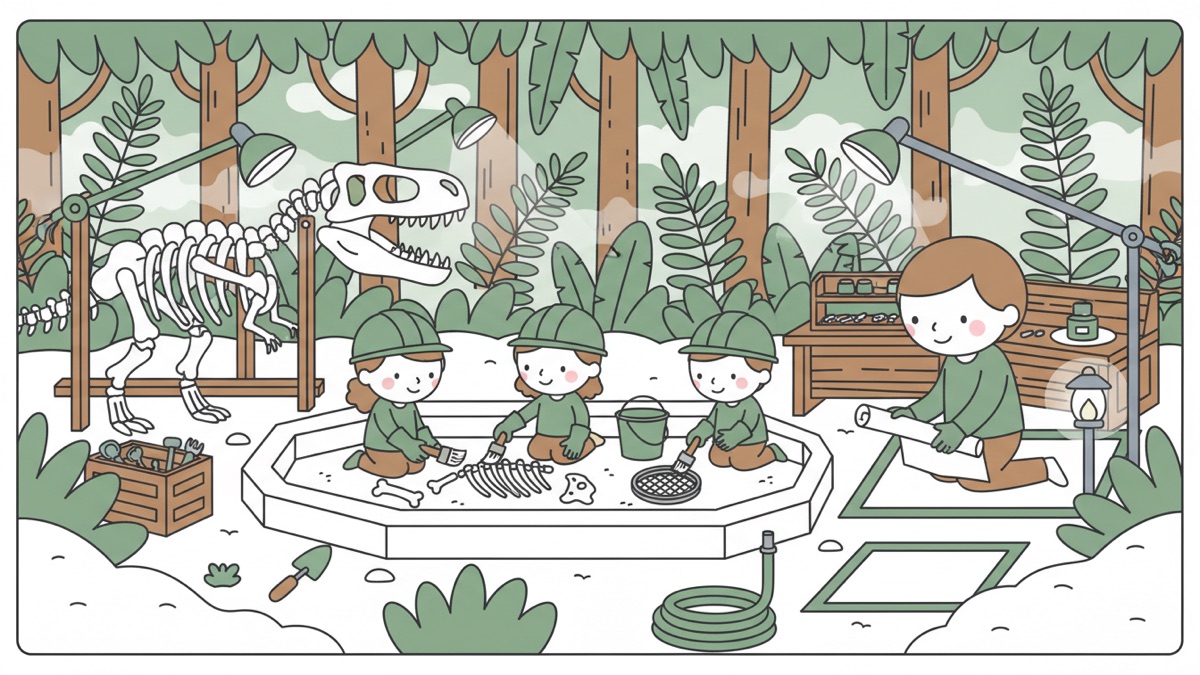
So we built the whole setting: a full-size skeleton, a realistic jungle set, the kit a field palaeontologist would actually wear, plus lighting and haze. We write our own course notes and draw our own illustrations.
None of this makes the fees cheaper, but it is the standard we have always held for equipment and settings — the reasoning is in why every child gets a research-grade microscope. The realism isn't there to photograph well. It's there because children are acutely sensitive to whether a thing is real. Once a child decides it's a toy, everything said afterwards is filed as a game.
Whether a class is any good rarely comes down to how novel the topic is. It comes down to how many points along the way the designers refused to be vague.