The only test we apply when we buy equipment: what can a child now do?
More kit doesn't mean better teaching. From the overseas curricula and materials we've seen, sensor-based measurement has been standard in science classrooms for over a decade — yet plenty of students here may never touch a temperature probe before university. We close that gap ourselves, but every purchase has to answer the same question.
Every so often we add another batch of equipment. People tend to read that as a posture — the more kit on the shelves, the more impressive the lab.
But when we actually decide whether to buy a machine, that isn't the question. The question is a much narrower one: with this in the room, what can a child do that they couldn't do before? If the honest answer is "it photographs well," it isn't worth buying.
The gap is specifically in digital measurement
There is one basic capability in hands-on science education that Taiwan has largely yet to close: measuring with sensors, and seeing the data as it happens.
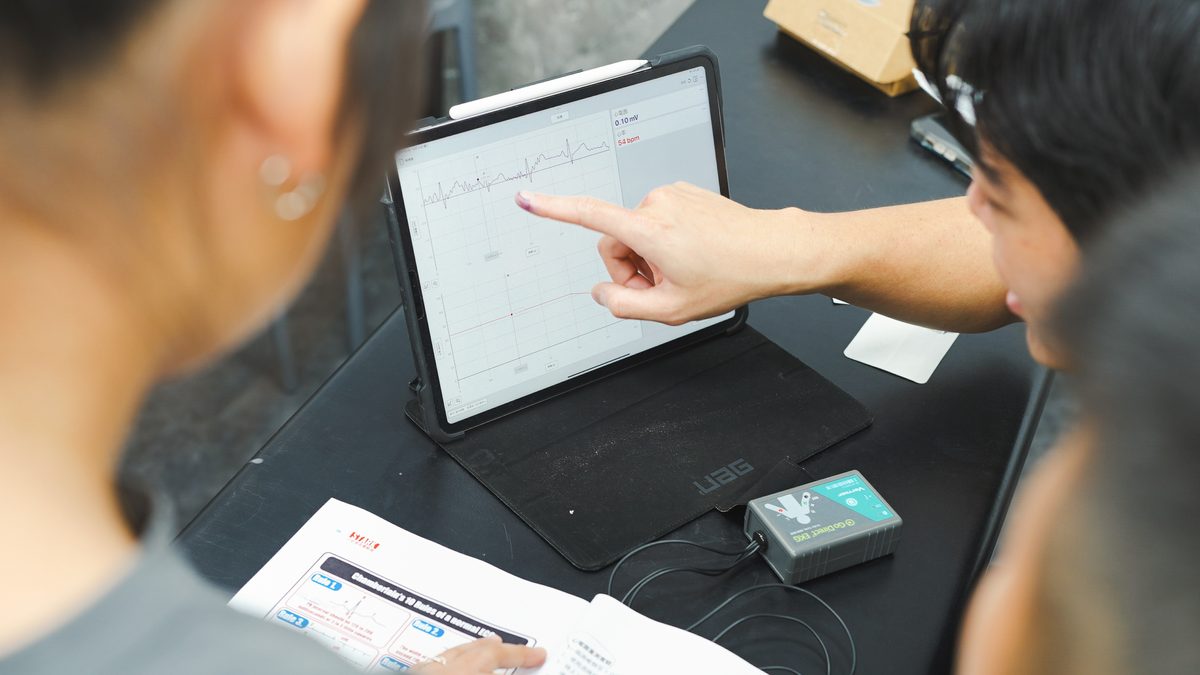
From the overseas curricula and teaching materials we've come across, this has been standard practice in European and American classrooms for well over a decade. Temperature, force, current, light intensity, pH, acceleration — all of it goes through probes into a laptop or tablet, plots itself into a live curve, and changes in front of the student while they work.
From what we see in schools and in teacher training here, most classrooms are still on traditional measurement, and some on pencil-and-paper derivation alone. A good number of students reach university without ever having connected a temperature probe themselves.
The difference isn't about how expensive the instruments are. It's whether measurement is a step the class actually performs, or a sentence the class skips over. When the data is live, an experiment can produce the moment that matters — why isn't this doing what I expected? — and that is where science starts.
So we've put equipment that normally lives in a university lab — a centrifuge, a horizontal electrophoresis tank — into a children's classroom, and made sensors a standing part of the kit rather than a special occasion. We keep them all on one platform, too, so that the handling a child learns in the junior years still applies when they get to a science fair project, with nothing to relearn.
Equipment has to land back in the lessons, or it's just stock
Buying the equipment is the easy part. The hard part is folding it back into the teaching: a new machine means redesigning the experiment around it, rewriting the lesson plan, and the teacher practising until it's second nature — only then does a child get to touch it.
An instrument that sits in a cabinet and never makes it into a lesson plan might as well not have been bought.
That's also why we don't describe ourselves in terms of a million dollars' worth of equipment. A figure isn't a specification. It doesn't tell you whether a child got a turn, whether they can operate it, or whether the numbers they collected were ever discussed. The question worth asking is a different one: in a single lesson, how many minutes does one child have their own hands on the apparatus? We've written about that trade-off in why every child gets a research-grade microscope.
Where the money comes from shapes how we buy
We have no investors and no shareholders. Every batch of equipment is course income put straight back in.
The upside is that nobody is pressing us to make the hardware pay for itself by a deadline. The cost is that we can only close one gap at a time, so the order has to be thought through. Our rule for that order is simple: start with what a child cannot get anywhere else. Where schools already manage it, we're in no hurry. Where schools can't, and it's central to understanding the science, we take it on ourselves.
Equipment depreciates; the gap doesn't close on its own. The only standard we can hold ourselves to is that every sum spent ends up in a child's hands, in an actual lesson.