

When the data starts moving: how the senses spark learning
When a child watches the numbers jump and the curve run in real time, the order of learning gets rewritten. Here's how live data feedback — see it, do it — lights up a child's motivation, one stage at a time.
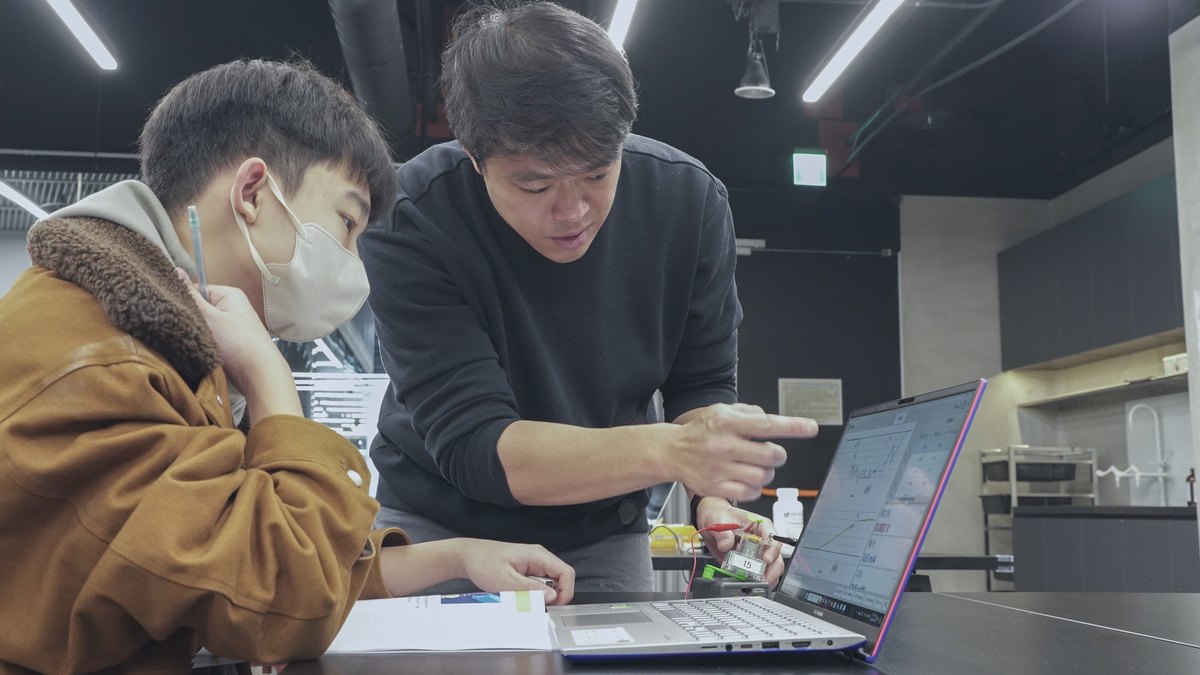
There's a kind of lesson where children start doing before they've fully grasped the principle. A sensor on the desk turns every move they make into numbers and curves that jump in real time — what they see is what they've just done.
We've watched a lot of children respond to this kind of live data feedback, and they nearly always pass through the same four stages.
It starts with watching the numbers move
Stage one: not quite following, but unable to stop. Even before they understand the principle, just seeing the numbers and charts keep changing makes them want to carry on — trying different variables, looking for ways to refine their own method.
Stage two: "Did I do this right?" Once there's data, a child spontaneously wants to understand it and check whether they got it right. That is the moment for the teacher to step in — walking the child through reading and analysing the data they produced with their own hands. (In a pendulum-period measurement, the effect at this stage is especially striking.) The child begins practising how to read a chart in order to confirm a theory.
Stage three: a surge of confidence. When a child can read their own data and confirm the result is accurate, the sense of achievement and the confidence arrive all at once.
Stage four: they can't help wanting more. With that confidence, the child starts thinking and asking questions unprompted — some even go looking for more on their own after class.
It's the kind of shift you usually have to witness in the room before you quite believe it.
Why the order matters so much
Some teachers and parents assume a lesson like this is just showing off equipment. But we've long been certain of one thing: when children learn experiment first, theory after, their motivation, their efficiency, and the quality of what they absorb all run far higher than under conventional teaching. The key is the stimulation of all the senses, right there in the moment.
A lot of children hit a wall the moment they reach junior-high physical science, and often it's for a simple reason: they have no idea what phenomenon the teacher is describing. They've never seen it, so as the explanation unfolds no image forms in their head to connect it to. Understanding never gets a foothold, and the results show it.
When a photo turns into a video
After running hands-on science courses for so many years, we were still willing to spend a great deal to bring in digital measurement tools — for one reason only. We were sure these tools would improve children's learning at an explosive rate.
When a child sees the numbers changing without pause and the curve running across the screen, the jolt is like a still photograph suddenly turning into moving footage.
Where they once pictured a "value" as a single fixed number, they now watch with their own eyes how a number actually changes — and realise that not every line simply climbs in a straight path; sometimes it dips first and rises later. At the same time, they start learning to read the charts they built themselves.
And that, as it happens, is one of the weakest links in the way science is currently taught in Taiwan.