The legendary class: inside Tainan First's science-class entrance
Tainan First Senior High's science class is the summit for the city's most driven science kids. How you get in, what it tests, and what life looks like once you're there — the whole path, laid out.
In Tainan, if a child shows an unusual hunger for maths and science from an early age, sooner or later a parent will hear the name: the science class at Tainan First Senior High. It's the stuff of legend — a "genius class" — and the goal many of the city's top students quietly set for themselves. But the road is long and genuinely demands talent. Before you point a child down it, it's worth seeing the whole thing clearly.
A note first: what follows describes how this kind of selection generally works. The exact subjects, scope, and dates for registration and each stage always follow the school's official prospectus for the current year.
Stage one: the written exam
This is where raw knowledge gets tested — languages (Chinese and English), mathematics, and the natural sciences (physics, chemistry, biology, and earth science). And it doesn't stop at the child's current grade: selections like this typically expect a solid grasp of first- and second-year senior-high material. That's why most children need to start laying the groundwork around the first year of junior high, to have enough time to really digest the upper-level content. (Actual subjects and scope follow the school's current-year prospectus.)
Stage two: the practical
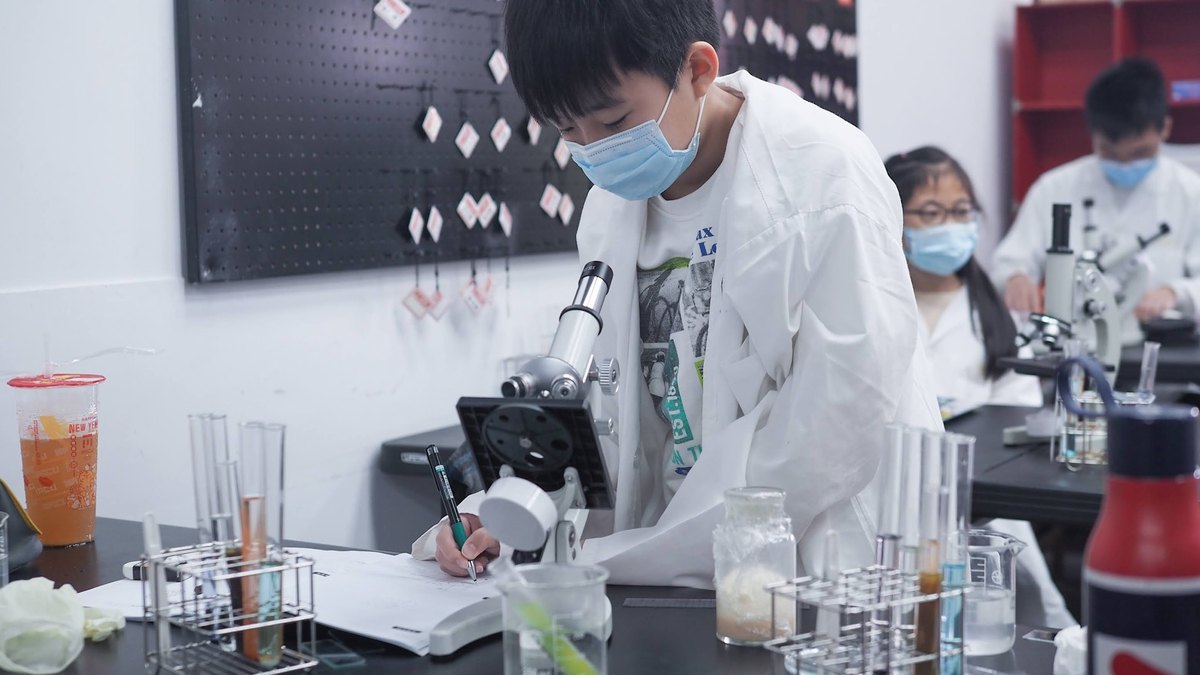
The written exam is only the entry ticket. What really separates candidates is often the hands-on round. It rewards reasoning — and it rewards feel. A child who isn't comfortable with lab equipment and procedures can burn precious time just getting set up.
Take the simplest example: titration. It reads like nothing in a textbook, but someone who has never handled a burette will stumble on how to even set it up and read the scale.
Microscopy is the same — how to sample, stain, and actually locate what you're looking for on a slide is something you build up over time, not something you can pick up on the spot. Everyone has done the theory prep; it's the hands-on practice that shows. There's no shortcut here. You have to actually do it — don't imagine that reading through the steps once is enough.
Stage three: the interview
By the interview stage, the format looks a lot like a university admissions interview, minus the enormous personal-statement dossier; at registration, candidates are usually asked to fill in some basics, such as why they're applying and a short self-recommendation.
What the interview is really hunting for is a child with genuine, burning motivation in maths and science — not one who is merely good at studying and has been pushed along by parents. So rather than rehearsing answers, a child is better off letting real enthusiasm show. (Worth noting: many children struggle even to articulate their own thoughts clearly — a deeper challenge, and one for another day.)
And once you're in?
Getting in is only the start. The science class generally compresses three years of senior-high curriculum into two, spends the freed-up time on research, and sends students to university to take calculus, general physics, general chemistry, and general biology. The load is heavy.
But this is a room full of prodigies. You'll see some children carry all of it with ease — studying well, researching well, even thriving in clubs.
Which is exactly why the path doesn't suit every child.
An ordinary rabbit that wanders into the jungle can have a very hard time of it — and if the experience knocks the wind out of a child's love of learning, the cost outweighs the prize.
So should you point your child down this road?
Our position has always been blunt: see it clearly, then decide. The science class is a stage built for children who already can't stop — who aren't being pushed, but are straining to run ahead on their own. If that's your child, the road is worth preparing for in earnest. If it isn't, squeezing in may not be the blessing it looks like. Think it through.