

Preparing for the Jiansing gifted program: why fourth grade is the start
No syllabus is published for the science section of the Jiansing gifted assessment, and no past papers are released. But answering it takes understanding that runs well past the elementary textbook — a long race you have to start early, and we think the starting line sits around fourth grade.
Every year, parents ask us the same question: my child wants to try for the Jiansing gifted program — when should we start preparing? Our answer usually gives people pause: around fourth grade. It sounds early. But once you see what the assessment actually tests, it makes sense.
Two notes first. What parents call "the Jiansing gifted exam" is formally the Tainan City Junior High School Math-Science Academic Aptitude Gifted Student Assessment and Placement, run city-wide by the Tainan City Department of Education. Jiansing Junior High is the assessment venue for the grade-6 math-science track and also hosts a math-science gifted resource class. And what follows is about pacing and method — actual eligibility and timing always follow the Department of Education's official guidelines for the current year. (Full breakdown of the rounds and subjects on our exam intel page.)
Why fourth grade
It isn't about how many books you can finish. It's about how deep the understanding has to go.
Per the Department of Education's published assessment items, the screening round tests achievement in mathematics and science; the final round is a hands-on math-science performance assessment plus academic aptitude tests. No syllabus is published, and no past papers are released — the "past papers" circulating privately are mostly reconstructions from memory and may not reflect the current year's format.
So what follows is our read from experience, not an official rule: watching children go through it, the concepts the questions reach for clearly sit above the level of the elementary science textbook. Answering them tends to require real understanding of core ideas in junior-high biology, physical science, and earth science.
Precisely because there is no syllabus to "finish," what you can prepare is not a sprint — it's depth. And depth takes time. Working backwards, starting around fourth grade is what makes the pace comfortable. Start too late and you're left rushing, and rushed understanding rarely survives contact with the hands-on round.
How can an elementary-schooler possibly grasp junior-high science?
That's the second question parents ask. The answer is in the order you do things.
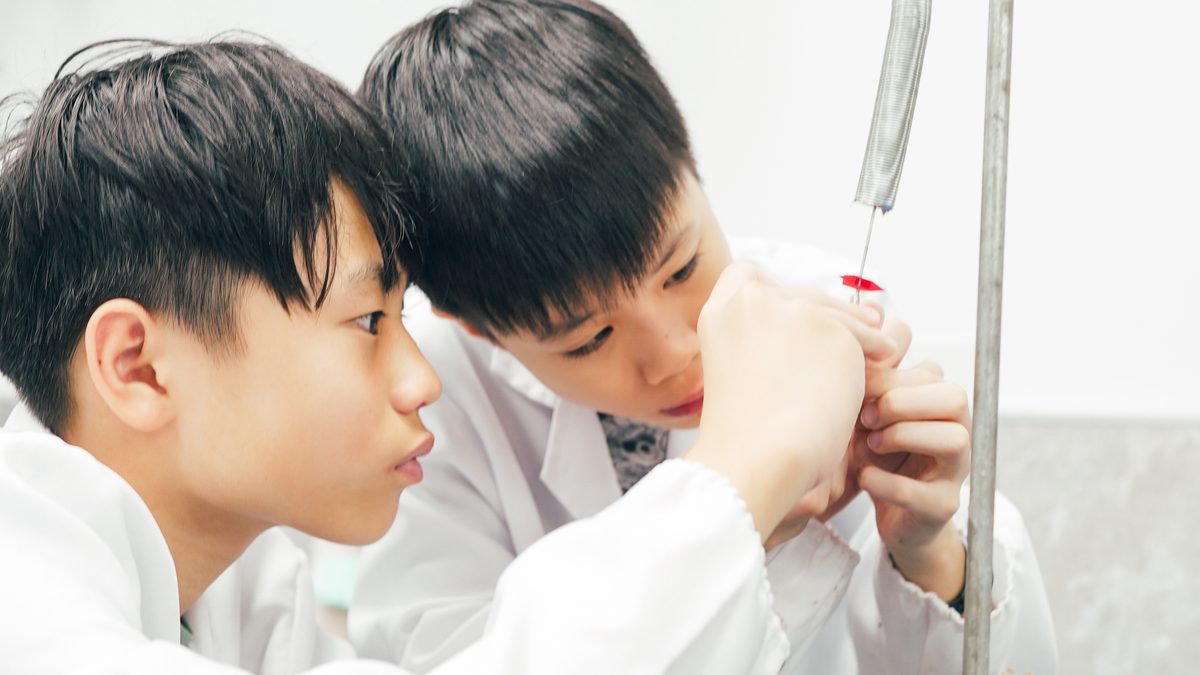
Our approach is simple: run the experiment first, observe first, and explain the theory after. If you ask an elementary child to understand osmosis, or circuits, or the rock cycle by opening with textbook definitions, of course it's hard. But let them see it with their own eyes and do it with their own hands first, then explain the reasoning behind what they just saw — and understanding tends to land almost immediately.
In other words, it isn't about shoving a junior-high textbook at a child early. It's about re-teaching the same material along a path an elementary child can actually absorb.
Early is not the same as forcing
The most common misreading of an early start is to picture early cramming. It's the opposite.
The whole point of a longer runway is not to rush — to give a child time to look slowly, ask slowly, and connect ideas slowly, rather than force-feeding three years of material in the final year before the exam. The real advantage isn't "studying early." It's having the time to actually understand.
One line for parents
If your child has a clear interest in science and can sit with a problem, then beginning around fourth grade — building on experiments and extending gradually into deeper concepts — is a steady, solid pace. Whether they ultimately sit the exam, and whether it suits them, is a separate question. But at least you won't have lost time before the race even starts.