

Double the plate and the whole chain has to be rebuilt — notes from a commercial shoot
Years ago we supplied the science apparatus for an education-themed commercial. Doubling the size of a metal plate looks like a change of dimensions; in practice the speaker, the amplifier and the levelling all had to change with it. What the shoot really taught us was that on set there is no second attempt.
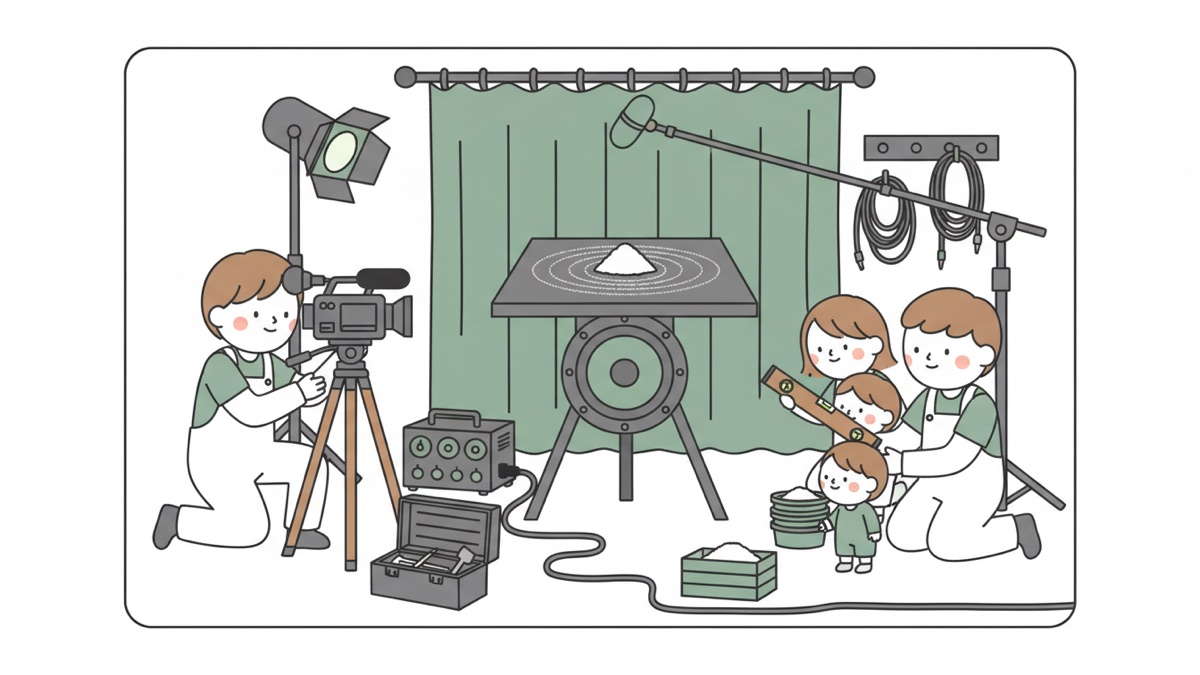
In 2018 an advertising agency rang to ask whether we could supply the science apparatus, and the technical support on set, for an education-themed brand commercial (the client was Samsung). It was a single shoot, and our part in it was narrow: make a scientific phenomenon repeat itself reliably in front of a camera.
What we were filming was a Chladni plate. A metal plate is mounted over a speaker; at particular frequencies the plate forms standing waves, and powder scattered across the surface is shaken off the areas moving hardest until it gathers along the nodal lines that barely move at all — leaving a symmetrical pattern. Change the frequency and the pattern changes entirely.
Doubling the plate isn't just a bigger plate
To make the pattern read clearly on camera, we doubled the size of the plate we normally use.
That is where the trouble starts. A larger plate is a heavier plate; a heavier plate is more than the original speaker can drive, so the speaker has to grow; a larger speaker needs more power, so the amplifier has to be upgraded too. And once the whole assembly is heavier, every error in levelling and alignment is magnified — let the surface sit even slightly off level and the powder slides to one side, so no pattern forms at all. The finished plate then went out for laser cutting and anodising before it counted as done.
A request that looks like "make it a bit bigger" propagates all the way down the physical chain. We meet this again every time we build a new piece of apparatus.
On set there is no second attempt
The rig was finished at the last possible moment on the afternoon before the shoot. We drove up through the night so the crew could test it.
After the test, the decision was made on the spot to switch to three-colour powder. It was already ten at night, and the stationery shops closed in half an hour. We tried three of them and came away with nothing — only certain shops stocked that grade of powder. The following morning, while the crew shot exteriors, we drove out to a neighbouring county to find some, and only just made it back in time.
On the day itself the large speaker was crushed twice, and we opened it up and repaired it there on the floor. Those two repairs left us with a line we've held onto ever since: the real preparation for a shoot isn't making sure nothing breaks, it's being able to fix what breaks. How well you know your own equipment decides whether you have any options at all in those ten minutes.
Ninety seconds of film, fourteen hours on set
The finished commercial runs under ninety seconds. Filming it took around fourteen hours.
There was a group of child actors on set. Those opening lines that look so unforced were drawn out of each child by the director over ten minutes or more of gentle questioning — "natural" is manufactured, not waited for. By evening, when everyone was flagging, the children were still willing to give it one more go, because they'd been promised they could take the coloured powder home.
The two of us were spent after twelve hours in a studio. After that day we understood the demands of that industry rather differently.
The experience did eventually come back into the classroom. Whenever we build a demonstration rig now, we ask the same question first: will it still work under the worst conditions it might face? Because a classroom is not so different from a set — the children are already gathered round, and there is no time to say "we'll skip this one today".